
For the past decade, MCLD’s work has been shaped by incredible people. Voices of the Decade is a new interview series featuring the leaders, partners, and changemakers who helped build our community. Their answers are human, thoughtful, and an encouraging reminder of MCLD’s impact. In this interview, our founder, Dr. John Coonrod, shares how MCLD started, what changes we’ve gone through, and how we maintain our values with over 3,000 members.
Dr. John Coonrod – Building MCLD
What does Community-led Development mean to you?
Community-led development represents the pathway to achieve Mahatma Gandhi’s mandate – “think of the face of the poorest persons you’ve ever seen and ask yourself if the action you contemplate will restore them to control over their own lives and destinies.” The vast majority of the lowest-income people are rural women, and so CLD must very intentionally transform the gender barriers that deny equal opportunities to women and girls. Also, it means taking a holistic approach – women and girls want to improve health, education, nutrition, public safety, and family income all at once, and hopefully all in the same place so they don’t spend hours a day walking from well to clinic to preschool. In so many areas, women are also the traditional stewards of the environment. So CLD requires action to support women’s rights organizations and their leadership, and for men to play a more equal role in household responsibilities.
Can you share a story that stands out from all the countries and communities you have visited to demonstrate community-led approaches making a true difference?
There are so many. When community-based organizations take collective action, it’s amazing what they can do with very little resources. In Nigeria, our members campaigned to prevent election violence [in 2023] — a time frame usually fraught with violence. With a mini grant of US$5,000, they mobilized in 13 states, reaching 1 million people directly and 10 million through the media. It proved to be the least violent election on record. When the young lawyer who coordinated it shared it on a call, he came to tears saying – “I know we saved lives.” They inspired our Sierra Leone colleagues to do the same for their election.
Another example: I saw first-hand how the women and girls in Bangladesh halt gender-based violence, including child marriage. A group of girls learned that one of their classmates was going to be married off too young and against her will and in violation of the law, and they all went together and talked the family out of it. Women in the village knew the auspicious days for weddings and sleuthed out where child weddings would be held and physically disrupted them. They convinced their elected male local leader to take a public stand – zero tolerance for domestic violence – and the woman took him to the families where violence was occurring and leaned on his authority to convince the husband to stop it. Then one woman shared one instance where even that didn’t work, and they bribed the police to beat him up.
What pivotal moment led to the creation of MCLD?
At The Hunger Project, we were committed to not only pioneering methodologies for women-centered, bottom-up development but also advocating for its widespread adoption. I was responsible for that second bit. My first strategy was to focus on participatory local democracy; however, in our top-down world, that was not gaining any traction with policymakers. Then in 2013, I came across the papers by think-tanks in Canada and Australia using the phrase “community-led development” – “working together to achieve locally owned visions and goals” and its principles perfectly aligned with our own. Shortly afterwards, I attended a congressional briefing on livestock by the head of Heifer International, Pierre Ferrari. He said, “As you know” (and of course I didn’t know), “Heifer is committed to holistic community development, but we find we need to spend at least a year transforming the psycho-social environment in which the poor lead their lives.” I thought, no, you guys just give goats, right? But I dug into their website and discovered that, like THP, they had a very systematic, step-by-step approach that matched CLD. Then I heard a lecture by Clare Lockhart making similar points in the humanitarian context of Afghanistan. I knew that CLD was an umbrella phrase that we could all fit into, in stark contrast to the prevailing top-down, paternalistic paradigm of aid.
How has MCLD changed in 10 years? How has the sector changed?
MCLD began as a policy advocacy campaign among INGOs. Many INGOs recognized that CLD was the right way to do development, but they were frustrated that the only funding was for top-down, short-term, single-sector projects. It meshed somewhat with the shift towards greater country ownership, and it crept forward in building greater clarity and increased commitment in bilateral and multilateral spaces. The big changes came about in 2020 with both Covid and the Black Lives Matter (BLM) racial reckoning. With Covid, outsiders got pulled out of communities and community leaders stepped forward to protect their neighbors – they needed a platform for collective voice and action, and for gaining access to accurate information. BLM forced INGOs to face some of the racist roots of international development, and triggered a real commitment to “decolonize aid.” Both of these forces led to a rapid growth and transformation of MCLD. We focused on building sustainable, resilient networks for collective voice and action among community-based and local organizations, and shifting the entire role for INGOs from being direct development actors to standing in authentic partnership with local actors.
As MCLD has expanded to 40+ countries, how do we maintain our core values?
I think there are two ways – we need to be sure our members all understand, own, and are aligned with our core values to begin with. Then we all need to find our moral voice, the stories that we can tell connect the dots between the concept of human dignity and our actions as CLD practitioners and champions.

In the current state of our world, what gives you hope?
I like Churchill’s quote, “For myself, I am an optimist – it does not seem to be much use to be anything else.” I find hope in the amazing creativity of CBOs to keep working in spite of all odds. Most recently, we organized a meeting where the researcher Rose Maruru of Senegal shared her findings of a survey of African CBOs – that 53% of them were successful in local, individual fundraising instead of wasting time writing grant proposals that they could never win. There are feminist funding networks not based on competition. Many grassroots organizations are finding ways to establish social enterprises to sustain their work. The slashing of bilateral aid is a terrible thing, but grassroots people are finding ways around it.
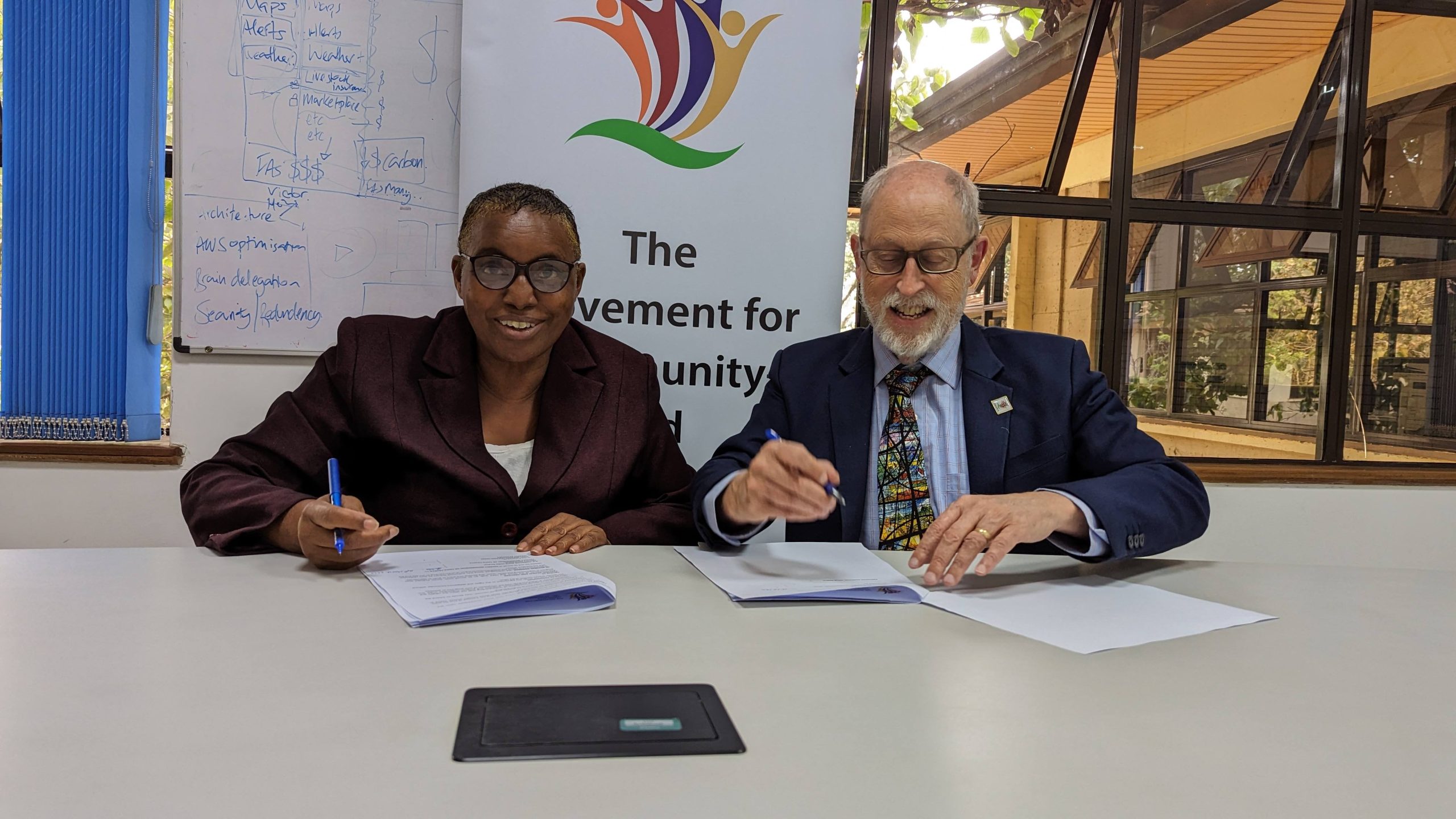
Featured Photo: John Coonrod Signing an MOU with Christine Saru Kilalo, Deputy Governor of Taita Taveta County, Kenya, 2023.