
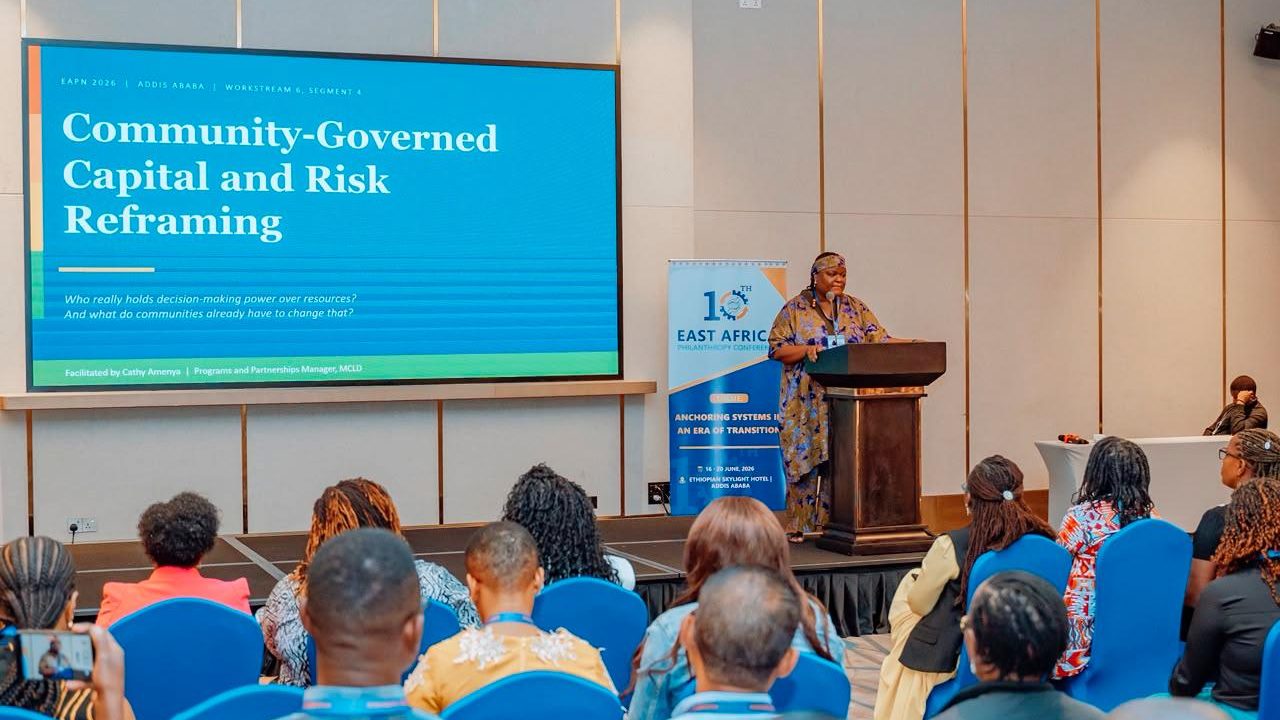
By Cathy Amenya, MCLD Programs and Partnerships Manager
I left the 10th East Africa Philanthropy Conference in Addis Ababa still thinking about one question, and it wasn’t the one I came with.
While I was there, I visited Mekedonia, a nonprofit founded by Biniam Belete in 2011 to alleviate the plight of destitute elderly people and people with mental illness, among the most vulnerable and overlooked people in society, in a place that is not fancy by any standard. We were shown a room where residents paint for recreation, and someone in our group suggested they sell the work. The person guiding us asked us to sit with that for a second. If we had sold those paintings, what would we, the visitors, have had left to appreciate the residents by? Further along, we were shown where residents make cleaning brushes in bulk, and again someone suggested turning it into an income stream. We made suggestions without anyone asking why the brushes existed in the first place. Maybe it was already cutting their own costs. Maybe it was giving residents purpose and something to do with their hands. We didn’t know, because we hadn’t asked, we had simply arrived with a solution. Then we reached the parcel of land where they plan to build a new hostel, and outside it sat five trucks for carrying sand and building materials. I asked who owned them. They did.
We had been there under two hours, and we had already handed out income ideas without knowing the first thing about their situation. Meanwhile they were running something more organised than most of what funder support builds in years, with land, trucks, a construction plan, and residents contributing as cooks, builders, and cleaners in a working hospital. Our good intentions arrived on top of capacity we hadn’t bothered to see first.
That confidence is worth interrogating. What gives a visitor, in under two hours, the standing to prescribe solutions for a place they have never lived in and do not understand? We would not do this at an architect’s office. We would assume the architect knows their own building, their own materials, their own constraints, and we would ask questions before we offered opinions. Somewhere in this sector, we stopped extending communities that same basic respect.
That is exactly how we behave with communities when we think for them instead of with them. This gap stayed with me through Workstream 6, where we facilitated a segment alongside colleagues each answering a piece of the same puzzle. @Elizabeth Makumbi, from @Bridgespan, laid out the landscape of intermediaries carrying capital to communities and the numbers behind them, funds calling themselves resilient to recent aid cuts, yet still needing roughly twice what they receive to operate as intended. @Winnie Watera, from @Women First Fund, showed what it looks like when a funder actually trusts communities with money on their own terms, unrestricted, multi-year, including a reserve the organisation controls outright. @Harvey Duthie, from @Belmont Fundraising, named the funding collapse this sector is living through as a systems failure rather than a funding gap, because intermediaries keep getting funded as projects instead of capitalised as the infrastructure they are. My segment sat in the middle of theirs. If the capital exists, and we have seen what trusting communities looks like, and we know the structures needed to hold it, the only question left is how.
Mekedonia is why that question matters more than any architecture. We can have Elizabeth’s capital, Winnie’s model, and Harvey’s structure, and still walk in and tell people what to do with what they have already built. The how has to start from the assumption that communities are entities with their own needs, thinking, and know how, not recipients waiting for our design to arrive.
This is the position MCLD insists on, and the same call the conference closed on, that communities must be at the centre of this work, not an afterthought once the design is finished, not managed at the periphery while the real decisions happen elsewhere. They have the agency and the dignity to solve their own problems. Sustainability cannot treat that as secondary. This has to be the starting point, or none of the rest holds.
I’m grateful for the conversations in that room, and for a sector willing to keep asking itself the harder question.