
For the past decade, MCLD’s work has been shaped by incredible people. Voices of the Decade is a new interview series featuring the leaders, partners, and changemakers who helped build our community. Their answers are human, thoughtful, and an encouraging reminder of MCLD’s impact. In this interview, Pascal Djohossou, MCLD’s West Africa Coordinator, reflects on MCLD’s growth in the region since its launch in Benin in 2017. From collective action on nutrition and health to building National Associations and advancing a community-led approach to systems change, Pascal shares lessons from nearly a decade of bringing communities, governments, and civil society together to drive change across West Africa.
Pascal Djohossou – Collective Action and CLD Across West Africa
Pascal, you were present at the launch of MCLD in Benin in 2017. Tell us about the journey since then.
The idea of community-led development and the change it entails is not always met with enthusiasm. At that time, even those of us who were not satisfied with the way development is implemented were unsure of how to change paradigms. When I started talking to people about MCLD, I heard “yes, there is a need to change, but how do we do that?”
The real first step was mobilizing ourselves around a shared vision and building confidence in it across the region. Meetings in Accra, Ghana, and Lomé, Togo, in April 2019 helped spark momentum across West Africa, with Nigeria joining shortly after.
Unexpectedly, COVID-19 became a catalyst for action. Across the region and even the world, the pandemic shook our conscience and woke us up. In Benin, we began connecting with the government [to mobilize mitigation efforts], building relationships with the Ministry of Health and the Ministry of Decentralization and Governance. We also deepened our connection with civil society organizations around the need to act together as a collective. Our activities [in response to the pandemic] became proof that we could be effective and take action, and we, as MCLD in West Africa, gained confidence from that experience.
What are some examples of the power of collective action that you have witnessed?
We, as CLD Benin, do a lot of collective action around nutrition. First, we think about how to use local superfoods1 and local crops in local recipes. For communities to support nutrition and the food system at the local level, this is essential. There are so many locally grown vegetables with high nutritional value that we can use to improve nutrition in communities. We have organized activities during World Food Day and Rural Women’s Day, all with partners at the university and government levels. By 2021, this work had helped position us as a hub for food system learning and action across West Africa.
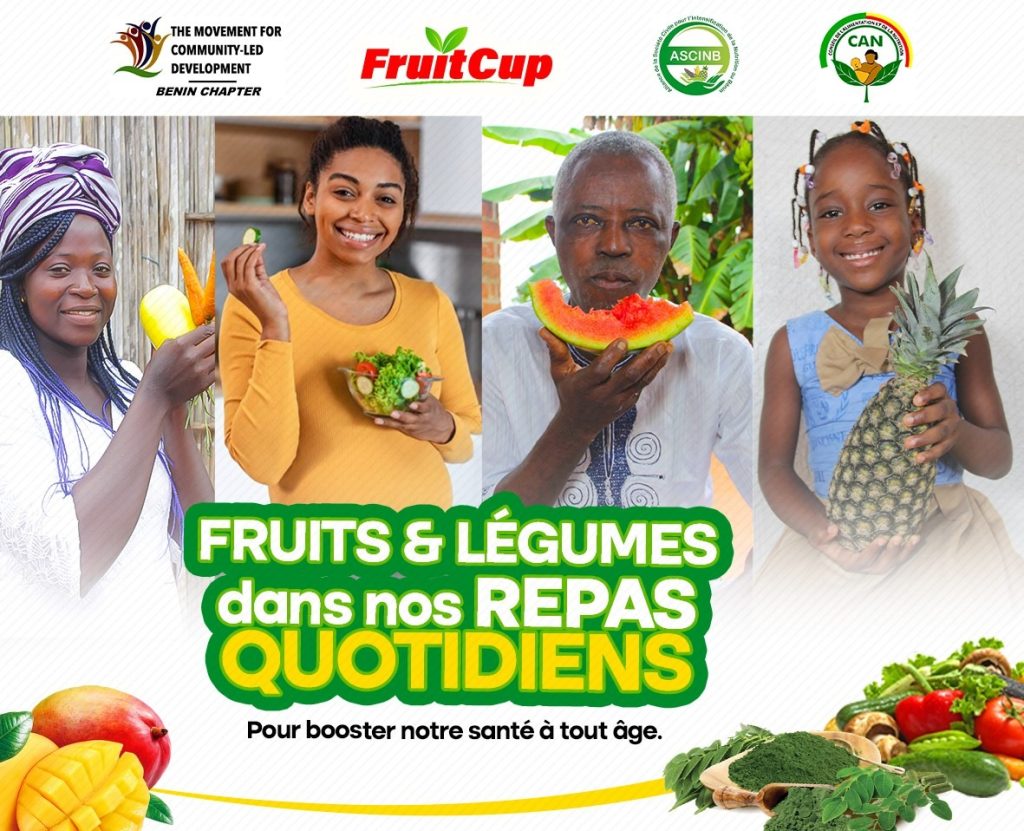
Also related to nutrition is our campaign about fruits and vegetables in our daily diet. Even with limited resources, the campaign gained national traction, with the government using our posters across the country.
Collective action is not only about the stakeholders involved. Each actor comes with its own role, and we have to consider how to connect the dots so that we are working in an ecosystem. The local government must be on board, like in our example with fruits and vegetables. MCLD civil society members and a private sector member started the initiative, and then it was amplified through the voice of ASCINB (Alliance de la Société Civile pour l’Intensification de la Nutrition au Bénin)2 and the governmental agency for nutrition called ANAN (Agence Nationale de l’Alimentation et de la Nutrition). We were able to raise awareness widely across Benin about the importance of diets with fruits and vegetables. To me, collective action is about creating the conditions for every stakeholder to contribute, amplify, and adapt.
What were some of the first initiatives you helped lead in West Africa and, more specifically, in Benin, where you started?
I was lucky to have had experience working at the national level in Benin and the perspective of what it means to both engage there and collaborate at the community, civil society, and government levels.
In Benin, one of our early initiatives was to collectively identify five priorities:
- Nutrition and Agriculture
- Governance
- Climate Change
- Well-being and Health
- Local Economy Development
We aim to understand how these priorities connect, so that we can move beyond siloed approaches. Together, they create the conditions for communities to grow, thrive, and lead their own development
I mentioned that COVID-19 was an opportunity for us to have an impact. An early initiative as a National Association was our awareness posters for healthy habits during the pandemic. We were able to contribute to the national plan to stop the spread of COVID-19 in Benin. We reached out to the Ministry of Health and its departmental bodies early in the pandemic to ask them what was missing and how we could contribute.
We initiated a series of posters with inputs from the Ministry of Health and the NGO Société Nationale de Nutrition. After gathering the perspectives of researchers, professionals, and local voices, our posters offered three new aspects to overall health: nutrition, physical exercise, and enough sleep. The umbrella organization, National Association of the Communes of Benin (ANCB), partnered with us to amplify the posters, which are still available on their website.
CLD Benin was already established, but our poster campaign was an opportunity to engage in a new area, start new connections, and share about MCLD more broadly across Benin.
What were some pivotal moments in West Africa that have shaped MCLD’s direction, and where is your focus now?
Currently, MCLD National Associations are present in 5 countries in West Africa: Benin, Liberia, Nigeria, Sierra Leone, and Togo, and one in Central Africa (the Central African Republic). What stands out most is the commitment shared across countries. We built early momentum because countries saw their peers taking action and building energy around our shared mission. And this is still going on, I’m seeing it now in Niger and in Cameroon, two countries that are beginning to engage with MCLD. We are a network built on mobilization, and expanding our collective impact has been part of our vision from the beginning.
Registering National Associations: Nigeria was the first National Association to formally register with their country’s government in 2020, and now we have five registered National Associations: Liberia, Sierra Leone, Togo, and Benin have joined Nigeria in registering. Registration is not a requirement; other countries are following MCLD’s approaches. For example, one individual in Congo-Brazzaville is very active in MCLD, including in our Gender Working Group, but we don’t have a National Association there. Groups of people in Niger, Burkina Faso, and the DRC are active participants in our work, but are not part of National Associations. This flexibility ensures that people can pursue what is valuable to them, whether or not they are part of National Associations.
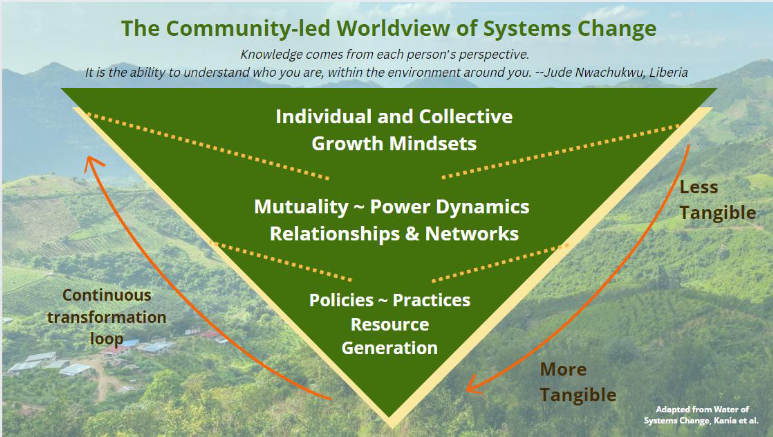
Designing The Community-led Worldview of Systems Change: I have always liked to refer to the Six Conditions of Systems Change. In 2023, my MCLD colleagues and I collaborated to reach across our network to adapt these six conditions into our Community-led Worldview of Systems Change. Some of the main elements I like from our model are the emphasis on mindset, partnership, and power dynamics. I share this graphic with people in West Africa – it has become a useful tool to leverage MCLD in the region and introduce people to our values. It starts conversations about power dynamics, about policies, and the need to improve and work together through collective action and challenge the status quo. It ties back to the need for collective action.
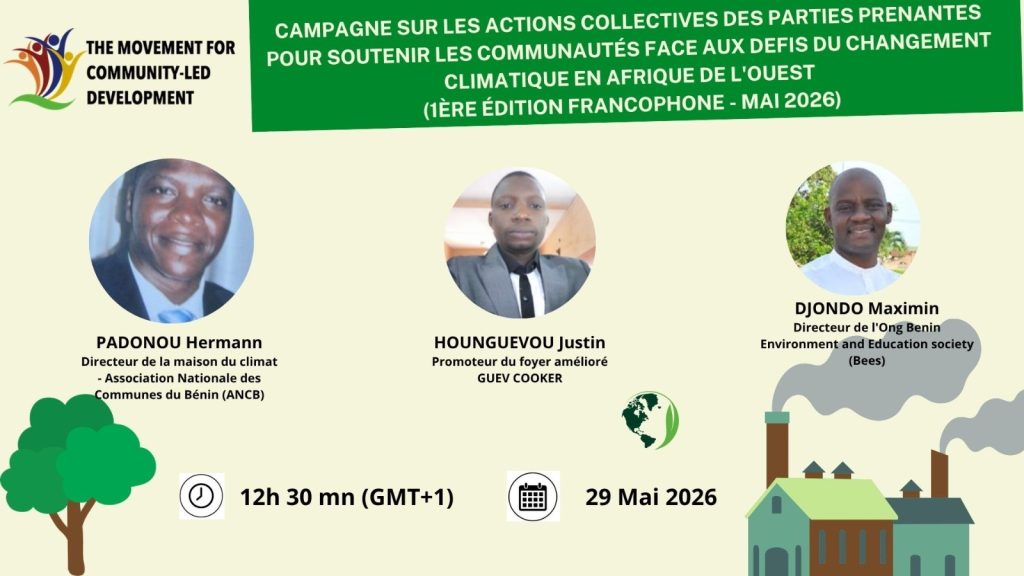
Leading Climate Change Campaigns: We have recently started a campaign focused on community-led climate change approaches, which kicked off with a meeting across six French-speaking countries: Benin, Togo, Burkina Faso, Niger, Burundi, the Central African Republic, and the Democratic Republic of Congo. We call it Campagne sur les actions collectives des parties prenantes pour soutenir les communautés face aux défis du changements climatiques en Afrique de l’ouest (Campaign on stakeholder collective action to support communities in addressing the challenges of climate change in West Africa). In this first meeting, we analyzed actions we can take in our communities to address climate change through the lens of the four pillars of MCLD’s strategic plan. The meeting series will continue with English-speaking countries in the region.
When you became regional coordinator, what did that role mean to you, and what were you hoping to achieve?
To me, the role of MCLD is to build a network where we feel really connected – not only virtually but also effectively. A network where we share trust and a commitment to changing the paradigm of development, ensuring that each action we take adds value to the ecosystem for transformation.
I kept this commitment when I became the Regional Coordinator of West Africa. Being a Regional Coordinator is an opportunity to help spark collective action, strengthen connections, and encourage innovation across the region. It helped me to renew and strengthen my commitment to change the status quo.
What message do you have for our 3000 members about how they can engage more deeply with MCLD?
Being a member of MCLD means you have a supportive space to be involved with new partners and learn from others. Connections need to be continually renewed so that new ideas, perspectives, and solutions can emerge. That is what MCLD offers. We are partners. We are co-creating the process. We are co-creating the system. And together, we are co-creating the change we have been waiting to see.

Pascal Djohossou is the Regional Coordinator for MCLD-West Africa, which he launched in 2017.
Pascal was educated in Benin, Côte d’Ivoire and France, with a specialty in forestry management. Before joining civil society, he worked for the Department for Forests and Natural Resources in the Ministry of Rural Development beginning, working in areas ranging from personnel, to direct care of forests, to coordination of reforestation programs. He has been involved in training grassroots leaders, non-governmental organization (NGO) workers and government staff in preserving and rebuilding the forests. His work has led him to publish many research papers and participate in many international site visits, conferences and training workshops. From 2001 to 2019 Mr. Djohossou served as the country director for The Hunger Project-Benin, as well as its regional director. He has a wealth of experience in grassroots mobilization as well as in the formulation of rural development policy.
Pascal’s hobbies include music, photography and the composition of poetry.
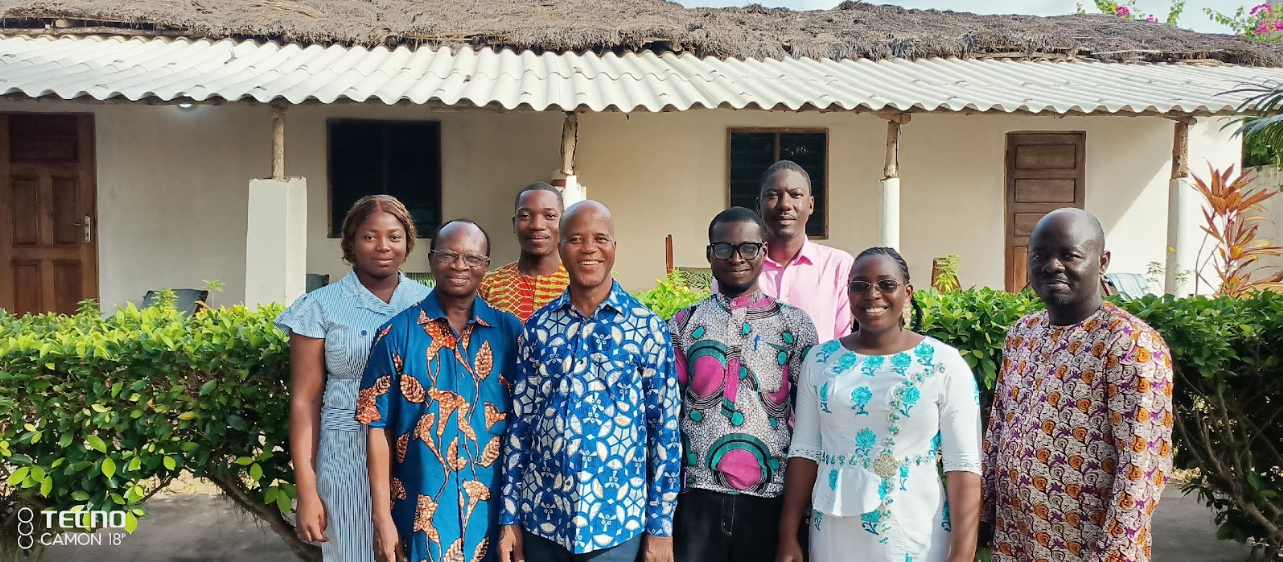
Featured Photo: Participants in the workshop from 21 to 23 November 2023 in Grand-Popo about co-designing the content of the campaign ‘’Fruits and vegetables in our daily diet’’ – Pascal is fourth from the left.
Footnotes:
1 – ‘Superfoods’ is a popular term for vitamin-rich, nutrient-dense foods
2 – ASCINB is the leading voice for Beninese civil society organizations (CSOs) working on food and nutrition security.
3 – The Community-led Worldview of Systems Change is a framework that begins with intangibles that can lead to tangible change. It is MCLD’s adaptation of FSG’s Six Conditions of Systems Change. The process of developing our worldview is outlined in this article in KM4Dev magazine.